Key Takeaways:
Moving day in DC can feel overwhelming when you’re wondering about parking rules for your moving truck. Most families discover too late that parking a moving truck on any DC street requires advance permits through DC’s Transportation Online Permitting System (TOPS). The good news is that getting the right paperwork protects you from costly fines and keeps your move running smoothly.
Here’s what you need to know: The answer to “do I need a parking permit for a moving truck in DC?” is yes—you’ll need a public space permit and Emergency No Parking signs for most residential moves. Washington, DC’s public space regulations require permits to reserve curb space, whether you’re moving from a rowhouse in Capitol Hill or an apartment in Dupont Circle. Great Job Moving and Storage handles permit coordination and sign posting so your family’s move stays on schedule and ticket-free, just like we do for families across Arlington and Northern Virginia. Contact our team to learn more.
Many families worry about navigating DC’s strict parking enforcement and dense urban streets on moving day. The city’s tight regulations mean most moving trucks need permits, but understanding the specific rules helps you avoid tickets and keep your move running smoothly for your children.
Yes, you need a public space permit for RPP zones, metered parking, and school zones. The permit temporarily reserves your space and suspends normal parking rules. Metered spaces require “meter bagging” (covering meters with official bags) plus additional fees beyond your standard permit cost.
Weekend and holiday moves still require permits to give you peace of mind. DDOT regulations apply seven days a week, though enforcement hours may be reduced on weekends. Your permit will specify exact enforcement windows for your location.
Private loading areas don’t require public space permits since you’re not using city streets. However, many families find dock access challenging due to size restrictions or limited hours. Professional movers like those at residential moving services coordinate both public permits and private access, while apartment moving specialists handle building-specific requirements seamlessly.
Out-of-state trucks follow the same DC moving truck parking permit rules as local vehicles. No additional state-specific permits are needed. Many families worry about this unnecessarily—focus on getting your standard public space permit and posting required signage within the designated timeframe.
Alleys and commercial zones follow similar permit requirements but often have stricter time limits or weight restrictions. Loading zones on commercial streets may have specific hours when trucks are prohibited. Always verify your exact location’s rules when applying to avoid surprises on moving day.
Getting the paperwork right means one less worry on moving day – your truck will have a legal spot waiting when it arrives. The process involves specific agencies, tight deadlines, and posted signs, but breaking it down into steps makes it manageable for busy families.
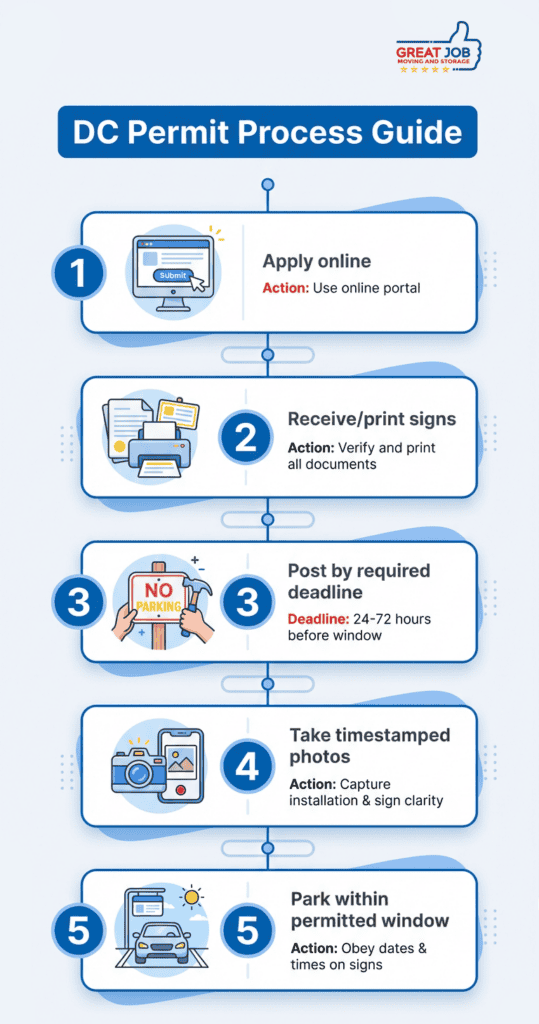
The District Department of Transportation (DDOT) issues permits for designated curb space through their TOPS (Transportation Online Permitting System), unlike ParkDC Permits, which only handles visitor parking. For moving trucks that need guaranteed curbside access, you’ll apply directly through DDOT’s TOPS portal. Permit fees typically range from $25-100, depending on location and duration.
Apply at least one week before your move date to allow processing time. Emergency No Parking signs must be displayed exactly 72 hours (3 full days) before your permitted time window begins. Set a phone reminder for 75 hours ahead – this small step prevents big headaches later.
Have your exact street address, preferred dates and times, estimated truck size (length and width), and any nearby meter numbers ready. You’ll also need to specify which side of the street and how many feet of parking space along the curb you need. Most box trucks require 25-30 feet of designated space.
DDOT provides the Emergency No Parking signs with your permit approval. Place one sign at each end of your assigned space, with signs facing oncoming traffic from both directions. Take photos with the date and time visible, showing each placed sign and its exact location as proof of proper display. Pro tip: Take photos from your car window – this proves they’re visible to drivers and saves time on moving day.
Permit modifications depend on availability and must be requested at least 48 hours before your original permitted time. Changes to dates, times, or locations require reprocessing through the same TOPS system. If you need flexibility with timing, companies like Great Job Moving and Storage can coordinate permits and adjust schedules as your plans evolve, letting you focus on your family instead of paperwork.
Knowing exactly what you’ll pay for a permit and how much space to reserve helps you budget accurately and avoid last-minute surprises. These questions cover the specific costs, timing rules, and space requirements that matter most on move day.
Public space permits for residential moves typically range from $50 to $135, depending on your location and how long you need the space. You might pay extra fees for meter bagging if you’re reserving metered spots. Paying for a permit protects you from parking fines that start at $300 for violations.
A typical 26-foot moving truck needs about 40-50 feet of curb space for safe loading and maneuvering. Smaller trucks require less footage, while larger vehicles need more room. You can include multiple trucks in your single permit application, but each vehicle must fit within your reserved space during the permitted hours.
Most permits allow up to 12 hours of reserved parking per day. Loading zones typically operate from 7:00 AM to 6:30 PM, Monday through Saturday. You can often split your permit into morning and afternoon windows if needed, giving you flexibility around your family’s schedule.
Yes, vehicles over 22 feet long or 8 feet wide face restrictions on many residential streets. The District Truck Map shows approved routes and prohibited areas like the Theodore Roosevelt Bridge. Check routing requirements before finalizing your permit location to avoid violations.
Contact DC’s non-emergency line at 311 immediately to request towing enforcement. Take photos showing your posted signs and the violating vehicle. Having your permit number and documentation ready speeds up the process. Professional movers offering residential services or apartment moves often handle these situations as part of their logistics coordination.
Even with careful planning, small oversights on move day can lead to expensive citations that disrupt your family’s schedule and budget. Don’t worry—these situations happen more often than you’d think, and knowing what to watch for helps you stay prepared and keep your move on track.
The biggest mistakes include posting signs less than 72 hours early, parking outside your time window, and using handwritten signs instead of official printed ones. DC now tracks permits automatically through your truck’s license plate, so expired permits show up immediately. Standard parking violations range from $25-$100, with specialty zone violations reaching $200+ — costs that can quickly strain a moving budget.
Keep your permit number handy and take timestamped photos of your posted signs and truck placement. DC’s automated tracking system makes it easier to verify valid permits during appeals since everything links to your license plate. Having clear evidence helps resolve disputes quickly without delaying your family’s move-in timeline.
Don’t panic if signs disappear—this happens more than you’d expect. Report missing or damaged signs to DDOT right away and document the situation with photos. Remember, signs must be printed at official locations like the Public Space Permitting Center—handwritten replacements will cost you $25 per sign. Many families choose professional movers who handle sign posting and monitoring to prevent these headaches.
Consider switching to a different block face, using alley access if your building allows it, or reserving space on a nearby street with fewer restrictions. Plan for about 18 feet per parking space when calculating how much curb length you need. If street parking becomes too complicated, residential moving services can often arrange alternative loading solutions that work better for your family’s schedule.
Yes, permits can’t override school zone hours, fire hydrant clearances, or active bus stops. Bike lanes and emergency vehicle zones also have rules that might make your permitted space unusable during certain times. Check your location using DC’s TOPS system before move day to avoid surprises that could delay getting your children settled into their new home.
Understanding Washington, DC moving regulations around permits, signage, and timing keeps your family’s move on schedule and ticket-free. The process involves applying through DDOT’s TOPS system, posting Emergency No Parking signs 72 hours ahead, and documenting everything properly.
Instead of managing this alone while caring for your children, let experienced professionals handle the logistics. Great Job Moving and Storage has managed permits and parking across 66,000+ moves with 99% customer satisfaction over 14+ years in the DC area.
Ready to skip the permit paperwork and parking worries? Schedule your residential move today and let our licensed team handle every detail while you focus on what matters most—your family’s smooth transition to your new home.